
A DMV Study Confirms Traffic School Works—So Why Was the Industry Never Told?
In August 2021, the California Department of Motor Vehicles published a comprehensive research report evaluating the effectiveness of California’s Traffic Violator School (TVS) program following the implementation of Assembly Bill 2499. The report—AB 2499: A Traffic Safety Evaluation of California’s Traffic Violator School Masked Conviction Program—was authored by the DMV’s own Research and Development Branch.
Despite the importance of its findings, this study was never meaningfully shared with the Traffic Violator School industry.
The report recently came to light through the independent research efforts of a California Alliance for Road Safety (CARS) member school. What it reveals is something traffic safety educators have long known—but have rarely seen formally acknowledged by the Department:
Traffic school works.
What the DMV’s Own Research Found
According to the DMV’s evaluation, the post-AB 2499 TVS program is associated with measurable improvements in traffic safety outcomes. Drivers who attended Traffic Violator School experienced statistically significant reductions in both subsequent traffic crashes and future citations compared to similarly situated drivers who received standard convictions.
The DMV estimated that the current TVS structure:
Prevents more than 1,100 traffic crashes each year
Saves approximately $63 million annually in economic crash costs
These are not marginal findings. They are substantial, data-driven outcomes drawn from hundreds of thousands of California driver records and analyzed using advanced statistical methods.
Even more importantly, the report does not stop at validating the current program—it goes further.
DMV Recommendations: Expand Education-Based Interventions
The study explicitly recommends expanding and enhancing traffic school–style educational interventions, including:
Better integration of TVS education with post-license control programs
Customized curriculum for repeat violators and higher-risk driver groups
Use of education as a proactive behavioral modification tool—not just a diversion option
In other words, the DMV’s own research supports the idea that education should play a larger role in California’s traffic safety framework—a position long advocated by traffic safety educators.
The Transparency Problem
Given the significance of these findings, the lack of transparency is troubling.
A DMV-commissioned study that demonstrates the effectiveness of Traffic Violator School programs—and supports expanding educational interventions—should have been shared with traffic safety educators, courts, and industry stakeholders. Instead, traffic schools were largely excluded from the conversation, even as policy decisions continued to be made that directly affect TVS programs statewide.
This absence of transparency raises important questions:
Why wasn’t this report proactively shared with the industry it evaluates?
Why were traffic safety educators left out of discussions about findings that directly validate their work?
How many other policy decisions are being shaped without industry input, despite clear evidence of effectiveness?
Why CARS Exists
This is exactly why the California Alliance for Road Safety (CARS) was formed.
CARS exists to ensure that traffic safety educators have a unified, informed, and credible voice in discussions about research, regulation, and legislation. When positive data exists—and is not shared—our role is to bring it forward, contextualize it, and ensure it informs policy.
This study is especially important as CARS works to advance legislation that would require traffic school attendance for every individual receiving a citation in California. The DMV’s own research now supports what the industry has long maintained: education changes behavior, reduces recidivism, and saves lives.
A state-published report from August 2021 that affirms the value of Traffic Violator School—yet remained largely undisclosed to the industry—makes one thing clear: traffic safety educators must advocate for themselves.
Traffic Safety Legislation Is Coming — Traffic Educators Must Have a Seat at the Table
A recent investigation published by CalMatters signals a pivotal moment for traffic safety policy in California. Lawmakers are openly discussing new legislation aimed at addressing dangerous driving behaviors, including impaired driving and other high-risk conduct on our roadways.
One key takeaway from the article is especially important for our industry: the California Department of Motor Vehicles (DMV) has told legislators that it needs increased funding to effectively implement and enforce traffic safety reforms. This acknowledgement underscores what traffic safety professionals have long understood — meaningful change requires both resources and smart, comprehensive strategies.
What We Know — and What We Don’t
While the article outlines clear legislative intent to strengthen traffic safety laws, many details remain unknown. Additional bills may be introduced in the coming weeks and months, potentially impacting licensing, penalties, diversion options, and education requirements.
What is not yet clear is how — or if — traffic education will be incorporated into these reforms.
Historically, traffic educators and traffic school providers have been largely absent from these policy conversations, despite playing a critical role in driver behavior change, compliance, and long-term safety outcomes. Decisions have too often been made without input from the professionals who work directly with drivers every day.
Why Traffic Educators Must Engage Now
Traffic safety is not achieved through enforcement alone. Education, intervention, and behavioral modification are essential components of any effective safety strategy. Traffic schools and educators are uniquely positioned to provide:
Proven behavior-change education
Scalable, court-connected diversion and intervention programs
Data-driven insights into driver behavior and compliance
Practical solutions that complement enforcement efforts
As lawmakers consider new approaches to roadway safety — and as DMV requests additional funding to support those efforts — traffic educators must be part of the discussion from the outset.
If we remain silent, policies may be shaped without recognizing the value of education-based solutions or the existing infrastructure already in place across the state.
A Call to Action for the Traffic Safety Industry
This moment presents both a challenge and an opportunity.
The challenge: legislation may move quickly, with limited opportunity for industry input unless we act now.
The opportunity: to come together as a unified industry voice and ensure that traffic safety policy reflects a balanced, effective approach that includes education, prevention, and accountability.
The California Alliance for Road Safety (CARS) believes that traffic educators are not peripheral stakeholders — we are essential partners in saving lives on California’s roads.
Now is the time for traffic schools, educators, and industry leaders to engage collectively, communicate with policymakers, and advocate for solutions that are informed by real-world experience and evidence-based practices.
Together, we can ensure that traffic safety reforms are not only tougher, but smarter, more effective, and sustainable.
CARS’ Position on California’s FAST Pilot Program: Enforcement Must Be Paired With Education!
The California Alliance for Road Safety (CARS) supports California’s ongoing efforts to address dangerous driving behaviors and reduce roadway fatalities. The recently announced FAST (Focused Acceleration Safety and Technology) pilot program—launched by the California Department of Motor Vehicles (DMV) in partnership with the California Highway Patrol (CHP)—is an important step toward holding the most reckless drivers accountable.
However, enforcement alone is not enough.
What the FAST Pilot Targets
The FAST pilot focuses on drivers cited for traveling over 100 miles per hour, a violation addressed under California Vehicle Code (CVC) §22348(b), which authorizes courts to impose enhanced penalties, including license suspension or revocation for extreme speed violations.
According to information shared regarding the FAST pilot, drivers cited at speeds exceeding 100 mph account for approximately 0.18% of all issued citations each year. While these violations are unquestionably dangerous, they represent a very small portion of overall speeding behavior occurring on California roadways.
Why Education Must Accompany License Action
Under the FAST pilot, administrative actions such as suspension or revocation may be imposed by the DMV. While these sanctions temporarily remove driving privileges, license actions alone do not correct the behavior that led to the violation.
CARS believes that when license suspension or revocation is imposed—particularly for violations under CVC §22348(b)—it should be paired with a mandatory behavioral modification and driver education program. Research and decades of traffic safety practice demonstrate that education is essential to reducing repeat offenses and long-term risky driving behaviors.
The Missing Middle: Excessive Speeders Below 100 MPH
CARS is particularly concerned about drivers traveling 25 miles per hour or more over the posted speed limit.
Despite the severity of this behavior, these drivers are not eligible for Traffic Violator School, which restricts traffic school attendance for excessive speed violations. As a result, a significant population of high-risk drivers receives punishment without any structured opportunity for behavioral correction.
This group represents a critical early intervention opportunity—before a serious crash occurs and before behavior escalates to the extreme speeds targeted by the FAST pilot.
A Proactive, Preventive Solution
CARS and its statewide membership of licensed traffic safety education providers are actively working to develop a standardized excessive-speed behavioral modification course. This program would be designed specifically for drivers cited at 25+ mph over the speed limit but below the 100-mph FAST threshold.
Such a course could be:
Ordered by courts as a mandatory condition
Incorporated into DMV administrative actions
Used in coordination with any driver’s license sanctions.
This approach aligns with California’s broader traffic safety goals and Vision Zero principles by emphasizing prevention, education, and behavior change rather than punishment alone.
Dangerous driving behaviors can be corrected through mandatory, high-quality education—before tragedy occurs.
CARS’ Role in Roadway Safety
The California Alliance for Road Safety (CARS) is a statewide trade and advocacy organization representing licensed traffic schools and driver education providers throughout California. Our mission is to improve roadway safety by promoting evidence-based education, supporting proactive policy solutions, and strengthening collaboration between regulators, courts, and traffic safety professionals.
CARS believes the FAST pilot can be strengthened by:
Pairing enforcement with mandatory education
Addressing excessive speeders before escalation occurs
Leveraging existing, regulated education providers statewide
Moving Forward
CARS looks forward to working collaboratively with the DMV, CHP, courts, and policymakers to ensure California’s traffic safety strategies are comprehensive, preventive, and effective.
Because safer roads are built not just through enforcement—but by changing behavior before lives are lost.
Key References
California Vehicle Code §22348(b) – Excessive speed (25+ mph over limit; 100+ mph violations)
California DMV & CHP – FAST Pilot Program (2025 announcement)
California Roads Are Killing Our Families — And Our Leaders Are Not Doing Enough About It!
December 11, 2025
Over the past decade, nearly 40,000 people have died and more than 2 million have been injured on California’s roads — a staggering human toll that deserves urgent attention. Yet, as a powerful new investigation from CalMatters reveals, state leaders have largely turned a blind eye to this crisis: 40,000 people died on California roads. State leaders looked away.
What’s the Problem?
The CalMatters series “License to Kill” exposes a systemic failure to confront dangerous driving and roadway violence across California:
Roadway deaths are rising sharply — after years of decline, fatalities have climbed more than 60% since 2010.
Dangerous drivers are staying on the road — repeat drunk drivers, chronic speeders, and motorists with documented histories of reckless behavior often continue driving, with deadly consequences.
California’s DUI laws are among the weakest in the nation, and despite a dramatic surge in alcohol-related traffic deaths, efforts to strengthen these laws have stalled or been weakened.
Where Leaders Have Failed
At a Senate Transportation Committee hearing, earlier this year, CalTrans showed lawmakers a stark chart of the climbing death toll — and barely received a question about it. Instead, legislators focused on unrelated topics like homeless encampments, gender identity on IDs, and gas taxes.
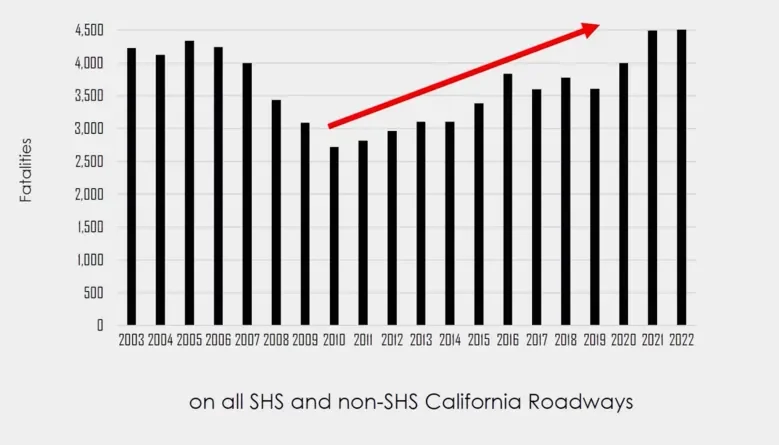
Chart presented at the Senate Transportation Committee hearing on March 11, 2025.
Meanwhile, the Department of Motor Vehicles continues to allow drivers with extreme histories of dangerous behavior to keep their licenses with minimal accountability.
Behind the Numbers: Real Families, Real Loss
The investigation highlights families devastated by preventable crashes. One father lost both of his children to a repeat drunk driver — and fought for a bill requiring in-car breathalyzers for DUI offenders, only to see it gutted. In Sacramento, families gathered for the World Day of Remembrance for Road Traffic Victims, illuminating the human cost of these policy failures.
Why This Matters for California
Every year, Californians lose neighbors, friends, siblings, parents and children to traffic violence that experts say could be reduced with stronger laws, better enforcement, and proven safety technologies. The state’s failure to act isn’t just troubling — it’s deadly.
This is not about politics. It’s about public safety, accountability, and protecting communities across California.
What CARS Calls For
To meaningfully address the mounting crisis on California roads, we urge policymakers to:
✅ Make traffic safety a top legislative priority, with regular hearings, transparent data reporting, community input, and measurable goals.
✅ Prioritize legislation that would require any individual in California who receives a traffic citation to complete a DMV licensed traffic violator school course.
✅ Empower the DMV to act decisively by revoking licenses of dangerous drivers and reporting relevant convictions promptly.
✅ Strengthen DUI laws — bring California in line with best-practice standards and ensure repeat offenders face real consequences.
How You Can Help
🚗 Share this post to raise awareness
📬 Contact your state legislators and demand action
📣 Join the CARS trade and advocacy group to strengthen our voice in demanding response from our leaders
🕯️ Honor victims by supporting policy change, not silence
Every Californian deserves safe streets. We must transform the outrage of rising roadway deaths into meaningful change — before more families pay the price.